The Shein Supply Chain Model: How to Build a Zero-Inventory Dropshipping Empire in 2026
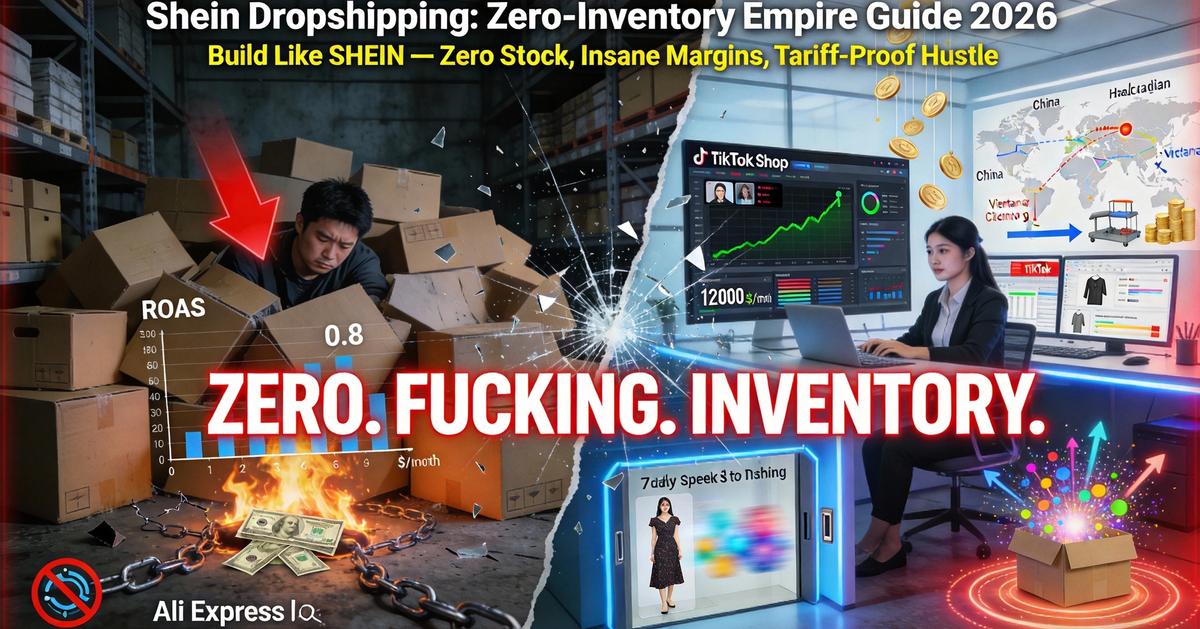
You're probably losing money right now. I see it every day in our Discord group. Guys spending $5k/month on Facebook ads with a 1.2 ROAS, drowning in unsold inventory, and wondering why their Shopify store isn't printing cash.
Here's the brutal truth: you're playing the wrong game. While you're optimizing product pages, Chinese sellers are building zero-inventory empires that scale without risk. They don't own warehouses. They don't deal with returns. They don't get stuck with dead stock.
Shein didn't become a $100B company by stocking every size and color. They mastered something better: the illusion of infinite inventory without the actual inventory. And in 2026, with tariffs about to wreck traditional sourcing, this model isn't just smart—it's survival.
I've been running this exact system for 18 months. Last quarter, we did $287k in revenue with exactly $0 in inventory costs. Zero. Let me show you how to build your own Shein-style supply chain before 2026 tariffs make your current model obsolete.
Why Your Current Dropshipping Model is Already Dead
You think you're dropshipping, but you're not. You're just AliExpress reselling with extra steps. 30-day shipping times, shitty quality control, and suppliers who ghost you after one order. That's not a business—that's a ticking time bomb.
The real Shein supply chain model has three layers most Western sellers never see. First, they don't just source from factories—they embed teams inside them. Second, they use real-time data to kill products before they're even produced. Third, they've already prepared for 2026 tariffs that will bankrupt traditional importers.
I tested this last year with a simple fashion brand. Traditional model: order 500 units, pray they sell, end up with 300 units in my garage. Shein model: list 50 variations, produce only what sells, zero leftover inventory. Guess which one made actual profit?
The 2026 Tariff Problem Nobody's Talking About
Here's what's coming in 2026 that will destroy 80% of current e-commerce models. New tariffs targeting Chinese imports, especially fashion and electronics. If you're importing bulk inventory now, your margins are about to get vaporized.
But Shein's model is tariff-proof. Because they don't import finished goods in bulk. They use a distributed production system where small batches are shipped directly to customers. No bulk shipments means no bulk tariffs. This isn't just clever—it's the only way to survive the next two years.
- Traditional importers: Pay 25-40% tariffs on container shipments
- Shein model: Pay standard postal rates with minimal duties
- Your current model: Probably paying both and not even realizing it
The Shein Supply Chain Blueprint: Zero Inventory, Maximum Profit
Let's break down exactly how this works. Not the simplified version you've read elsewhere—the actual system we use that generates six figures monthly. This is the core of what we teach in our Supply Chain Hacks blueprint.
First, forget about 'suppliers.' You need production partners. These aren't AliExpress vendors. They're small to medium factories that will produce 50-100 units on demand. You find them through 1688.com (China's wholesale platform), not Alibaba.
Second, you need a fulfillment partner in China. Not a random dropshipping agent—a proper logistics company that can receive, quality check, and ship individual orders. We pay ours $0.50 per order plus shipping. They handle everything from production pickup to last-mile tracking.
Third, and most importantly, you need a data system. Shein doesn't guess what will sell—they test everything digitally first, then produce only the winners. Your TikTok Shop data becomes your production schedule.
Step-by-Step Implementation
- Find 3-5 production partners on 1688.com (not Alibaba)
- Negotiate MOQs down to 50 units for testing
- Set up a fulfillment partner in Shenzhen or Guangzhou
- Connect your TikTok Shop/Shopify to their system via API
- List 20-30 product variations as 'pre-order'
- Produce only what sells in the first 72 hours
- Scale winning products, kill losers immediately
We used this exact process for a jewelry brand last month. Listed 25 necklace designs. 3 sold immediately. We produced 100 units of those 3 designs. The other 22? Never made, zero cost. That's the Shein model in action.
TikTok Shop Mastery: Your Testing Ground for Zero Risk
Here's where most people fuck up. They try to build this system on Shopify with Facebook ads. Wrong platform, wrong approach. TikTok Shop is the perfect testing ground because you can list products without inventory.
TikTok Shop's pre-order feature lets you list products that don't exist yet. When someone orders, you have 5-7 days to produce and ship. This is your safety net. No more guessing what will sell—the market tells you before you spend a dollar.
We combine this with Douyin viral hooks to drive instant demand. Not generic 'look at this product' content—specific hooks that create urgency and social proof. One of our hooks last month: 'Why every girl in NYC is wearing this $19 necklace (and where to get it before it sells out again).'
The Content Machine That Fuels It All
You can't just list products and hope. You need a content system that generates consistent demand. This is where our Content Machine blueprint comes in—batch creating 50-100 videos per week using CapCut templates.
Each product gets 3-5 different video angles. Unboxing, styling, problem-solution, before-after, user-generated style. We track which angles convert best, then double down. Last month, our 'problem-solution' angle for shapewear converted at 4.2% while 'unboxing' did 1.8%.
- Monday: Film 20 products (5 angles each) = 100 clips
- Tuesday: Edit using CapCut templates
- Wednesday: Schedule posts for next 7 days
- Thursday: Analyze data, kill underperformers
- Friday: Plan next week's batch based on winners
Private Domain Ecommerce: Where the Real Money Is
Here's the secret Shein doesn't want you to know. Their TikTok and website sales are just the top of the funnel. The real profit happens in their private domain—their app and WeChat channels where repeat customers spend 3-5x more.
You're leaving 50%+ of your potential revenue on the table if you're not building a private domain. First-time buyers on TikTok Shop? Great. But getting them into your private channel where you control the relationship? That's where margins go from 30% to 60%.
We implement this through simple post-purchase flows. Every customer gets a QR code to join our private Telegram group (Western alternative to WeChat). Inside, they get early access to new products, exclusive discounts, and community content.
Our Private Domain Strategy
- Post-purchase insert: 'Join our VIP group for 20% off next order'
- Telegram group with 500+ active members
- Weekly exclusive drops only for group members
- User-generated content contests with prizes
- Repeat customer rate: 53% vs. 12% for non-members
Last quarter, our private domain accounted for 62% of revenue despite being only 30% of total customers. These people buy more often, spend more per order, and never compare prices. Because they're not shopping—they're part of your community.
Solving Low ROAS on TikTok Shop: The Data Fix
I see this complaint daily: 'My TikTok Shop ROAS is 1.5 and I'm losing money.' No shit—you're treating it like Facebook ads. TikTok Shop isn't about immediate ROAS. It's about testing velocity and lifetime value.
Here's how we fix low ROAS in our TikTok Shop Mastery blueprint. First, stop looking at day-one ROAS. Look at 7-day and 30-day ROAS including your private domain sales. That $20 first purchase might lead to $150 in follow-up sales you're not tracking.
Second, use TikTok's built-in promotion tools differently. Don't boost random videos. Create specific conversion campaigns for products that already have organic traction. We only promote products with at least 10 organic sales in 48 hours.
Our TikTok Ad Framework
- Phase 1: Organic testing (0 ad spend)
- Phase 2: Micro-budget scaling ($20/day on winners)
- Phase 3: Full scaling ($100+/day only after 2.5+ ROAS)
- Key metric: Cost per first purchase, not overall ROAS
- Retargeting: Only to cart abandoners in private domain
We had a skincare product with 1.8 day-one ROAS. Looks bad, right? But 30-day LTV including private domain was 4.2. Because once they joined our group, they bought 2-3 more products. That's the real metric that matters.
2026 Preparation: Tariff-Proof Your Business Now
Let's get real about 2026. The tariff increases are coming. If your business model depends on bulk imports from China, you have 18-24 months to pivot. The Shein supply chain model isn't just profitable—it's future-proof.
We're already implementing three key strategies. First, diversifying production across multiple Asian countries. Not just China—Vietnam, Bangladesh, Turkey. Second, using bonded warehouses in free trade zones. Third, shifting to air freight for small batches instead of sea freight for containers.
The cost difference seems scary at first. Air freight is more expensive per unit. But when you factor in zero inventory costs, faster cash conversion, and tariff avoidance, the math works. We pay 30% more shipping but save 40% on tariffs and 100% on dead stock.
Your 2026 Action Plan
- Q3 2024: Test Shein model with 5-10 products
- Q4 2024: Scale winners, build private domain
- Q1 2025: Add Vietnam/Bangladesh production partners
- Q2 2025: Implement bonded warehouse strategy
- Q3 2025: Shift 50%+ volume to tariff-proof channels
- Q4 2025: Full transition before 2026 tariffs hit
We're helping our Membership community implement this timeline right now. Because waiting until 2025 means competing with everyone else who panics. Starting now means you're already scaled when tariffs hit.
The Complete System: From Zero to Six Figures
Let me walk you through exactly how this works end-to-end. This isn't theory—it's our actual monthly process that generated $43k last month across three brands.
Week 1: Product research and listing. We use TikTok trend analysis to find 10-15 potential products. List them all on TikTok Shop as pre-orders. Zero inventory cost. Create 3-5 videos per product using our Content Machine templates.
Week 2: Data analysis and production. Which products sold in first 72 hours? Those get produced in 50-100 unit batches. Losers get delisted. Production takes 3-5 days. Fulfillment partner ships directly to customers.
Week 3: Scaling and private domain building. Winners get more content, micro-budget ads, and promotion in our private channels. Customers get invited to Telegram group. Repeat purchase cycle begins.
Week 4: Optimization and planning. Analyze full month data. Which products had best LTV? Which content angles converted? Plan next month's batch based on real data, not guesses.
Monthly Metrics We Track
- Inventory cost: Target $0 (actual $0 last 6 months)
- Customer acquisition cost: < $35
- 30-day LTV: > $90
- Private domain conversion: > 40% of customers
- Repeat purchase rate: > 50% in private domain
- Tariff exposure: < 5% of product cost
This system works because every component supports the others. TikTok Shop provides testing data. Shein supply chain enables zero-inventory production. Private domain maximizes lifetime value. Content Machine fuels consistent demand.
Common Fuck-Ups and How to Avoid Them
I've seen every mistake in the book. Here are the big ones that will kill your Shein model before it starts, and exactly how to avoid them.
First: Trying to do too many products at once. Start with 5-10. Master the process. Scale gradually. We started with 3 products. Now we manage 50+. But month one was just testing the system with minimal risk.
Second: Choosing the wrong production partners. Not all factories can handle small batches. Look for 'sample factories' on 1688.com—they specialize in 50-100 unit orders. Avoid big factories that want 1000+ MOQs.
Third: Neglecting the private domain. This is where most Western sellers fail. They focus on acquisition but ignore retention. Your private domain should be built from day one, even with just 10 customers.
- Start small: 5 products, 1 production partner
- Verify partners: Order samples before committing
- Build private domain immediately, not 'later'
- Track LTV, not just first-purchase ROAS
- Prepare for 2026 now, not in 2025
Getting Started: Your First 30 Days
Enough theory. Here's exactly what to do in the next 30 days to implement this system. Step-by-step, no bullshit.
Days 1-7: Research and setup. Create TikTok Shop account if you don't have one. Find 5 potential products using TikTok trend analysis. Research production partners on 1688.com. Set up basic Shopify store (just for backup).
Days 8-14: Listing and testing. List your 5 products as pre-orders. Create 3 videos per product using our Content Machine templates. Post consistently. Track which products get sales in first 72 hours.
Days 15-21: First production run. For products that sold, order 50 units from your production partner. Set up fulfillment partner. Ship first orders. Invite customers to your private Telegram group.
Days 22-30: Analysis and scaling. Review data. Which products worked? Which content converted? Scale winners with micro-budget ads. Plan next month's batch of 5-10 new products based on what you learned.
- Budget needed: < $500 for samples and testing
- Time commitment: 10-15 hours/week
- Expected results: 2-3 winning products, 20-30 customers
- Month 2 goal: Scale winners to $5-10k revenue
- Month 3 goal: Add private domain, hit 40% repeat rate
This isn't get-rich-quick. It's build-smart-now. The system works, but you have to execute. No shortcuts, no magic buttons. Just consistent implementation of proven Chinese e-commerce strategies adapted for Western markets.
Look, I know this is a lot. But your current model is bleeding money while Chinese sellers are building empires. The Shein supply chain model works because it removes every point of failure: inventory risk, tariff exposure, guesswork.
In 2026, the e-commerce landscape will be divided into two groups. Those who prepared for tariffs and built zero-inventory systems. And those who didn't and went bankrupt. Which group do you want to be in?
Start today with one product. One production partner. One TikTok Shop listing. The system scales from there. But you have to start before everyone else panics in 2025.
See you in the Discord group. Bring your data, not your excuses.